Why Grease and Odor Build Up on Restaurant Concrete
How grease penetrates restaurant concrete, why it causes odor and pests, and why hot-water degreasing is the only real fix.
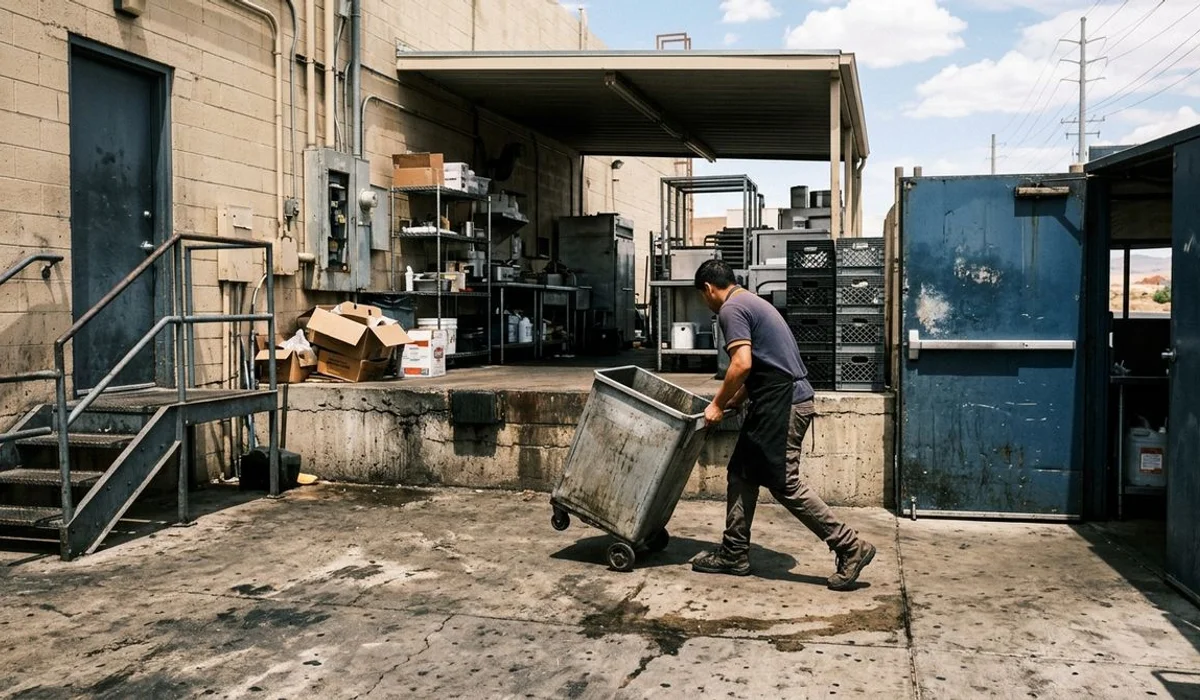
We know the frustration of looking at a freshly washed dumpster pad only to see the stains return days later.
That persistent restaurant concrete grease odor is a major headache for commercial property managers and HOAs. Routine maintenance often misses the root cause of the problem.
Our team evaluates three main factors to fix this permanently in Clark County. First, the cleaning method must match the exact surface material.
High pressure works for durable concrete, soft washing handles stucco, pure water cleans solar panels, and specialty chemistry treats rust or acid stains.
We match the service schedule to align with your property operations. This means overnight shifts for commercial spaces, daytime hours for residential areas, and low-impact methods around HOA residents.
The final standard must strictly follow local regulations.
Our process ensures you meet EPA guidelines, Southern Nevada Water Authority rules, and strict city appearance codes. Let’s look at the science behind the stains and how to fix it properly.
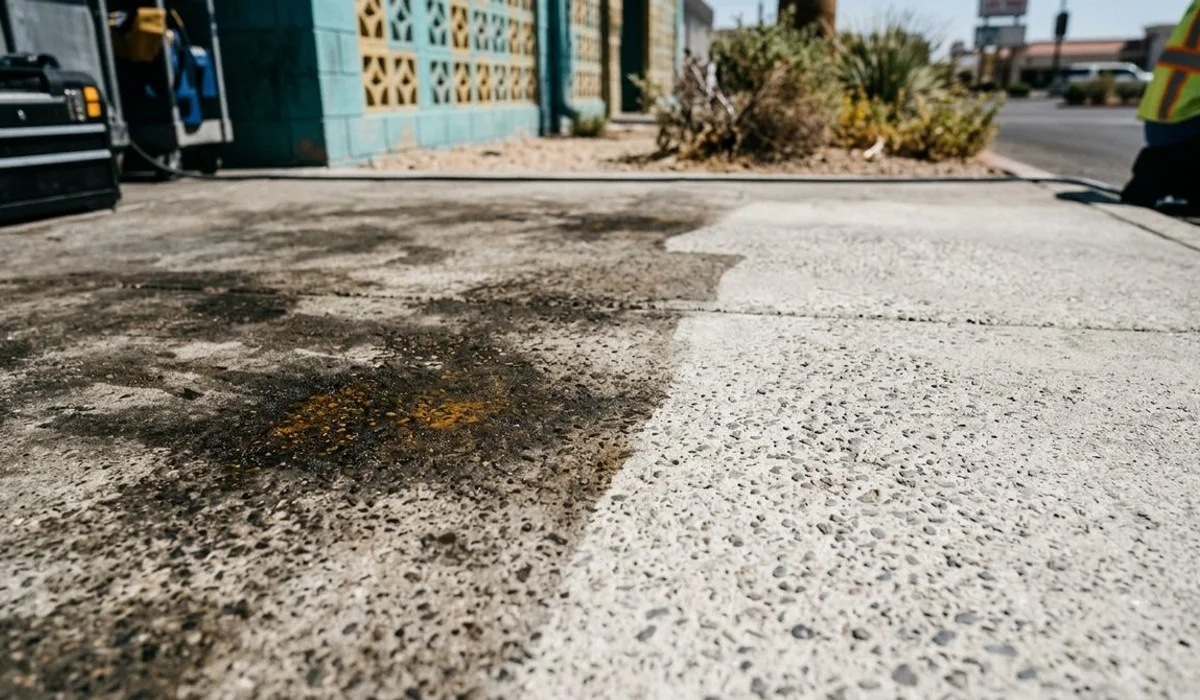
How grease soaks into porous concrete
How does grease soak into porous concrete? Grease soaks into porous concrete through capillary action because standard concrete actually contains 15 to 20 percent air voids by volume.
These microscopic channels act like a sponge when exposed to hot cooking oils and animal fats.
We often see property managers assume a gray slab is a solid barrier against spills. The reality is much different.
Oil actively migrates downward and outward through the porous structure until it reaches a density it cannot pass.
Our technicians use targeted enzymatic cleaners to pull these deep stains out safely. New concrete has a tighter pore structure, but older weathered surfaces in Las Vegas absorb liquids rapidly.
Let’s break down the mechanics of grease penetration.
- Dry concrete absorption: Dry concrete absorbs moisture significantly faster than wet concrete.
- Capillary action: Liquid fats are drawn deep into the microscopic voids.
- Temperature expansion: Heat causes the pores to open up and accept more fluid.
- Polymerization: Oils harden into a solid plastic-like resin over time.
Odor and pest consequences
What are the odor and pest consequences of dirty concrete? The primary odor and pest consequences are severe health code violations and immediate infestations of rodents and cockroaches.
Rotting organic matter trapped in the concrete pores releases a foul restaurant pad odor as it bakes in the Las Vegas sun.
Our daily commercial cleaning routes show us exactly how quickly pests find these areas. The Southern Nevada Health District conducts unannounced inspections at least once a year.
A filthy dumpster area can quickly lead to demerits for pest harborage conditions.
We warn clients about the risk of costly forced closures if inspectors find liquid grease overflowing onto the street. A 2023 SNHD monthly report highlighted multiple closures specifically for poor liquid waste disposal.
Mold thrives when organic matter meets constant moisture in the ideal 77 to 86-degree temperature range.
Stopping Restaurant Concrete Grease Odor
Our team strongly recommends proactive cleaning to avoid these common citations, which raises the practical question of how often restaurants should clean dumpster pads. The cost of prevention is far lower than the lost revenue from a health department shutdown.
| Consequence Type | Specific Threat | Regulatory Impact |
|---|---|---|
| Microbial Growth | Mold and bacteria colonies | Foul odors leading to complaints |
| Pest Infestation | Roaches, rats, and flies | SNHD health code demerits |
| Structural Damage | Acidic breakdown of cement | Expensive concrete replacement |
| Environmental | Runoff entering storm drains | EPA and city fines |
Why cold water and soap fail
Why do cold water and soap fail to remove grease? Cold water and soap fail because cooking oils harden into solid polymers that require temperatures above 140 degrees Fahrenheit just to begin melting.
Standard cold water merely pushes the solid grease around and often drives it deeper into the concrete.
We rely on industrial hot water pressure washers that hit 180 to 200 degrees to actually break the chemical bonds. This extreme heat emulsifies the hardened fats.
The heavy oils turn back into a thin liquid that can be safely extracted and washed away.
Our preferred method involves alkaline degreasers to target hydrocarbon bonds effectively. Using standard dish soap on a heavy oil spill is a waste of labor.
Cold water pressure washing might remove loose dirt, but it leaves the embedded grease in concrete completely untouched.
The Temperature Difference
Our company knows that the right temperature is the secret to a lasting clean. Heat lowers the thickness of oils dramatically.
- Cold Water (Under 100°F): Smears grease across the surface and leaves a slippery film.
- Warm Water (100°F to 139°F): Softens the top layer but fails to penetrate the pores.
- Melting Point (140°F): Begins to dissolve the solid structure of cooking fats.
- Emulsification (180°F to 200°F): Completely liquefies the grease for safe removal.
Bottom Line
Our company, Pressure Washer Las Vegas, was established to set a new standard for exterior cleaning and property maintenance in the community. Eliminating that restaurant concrete grease odor is critical for your business reputation.
If you need a no-pressure walkthrough, our team can quote your specific property and recommend the right method and frequency. See our parent service page for full details on the work involved, or request a free quote to get same-day pricing across Las Vegas, North Las Vegas, Henderson, and Summerlin.
Every job is backed by a money-back guarantee. Reach out today to schedule your consultation.